Card Show Tips for Beginners: A First-Timer's Guide
What to Expect at Your First Card Show
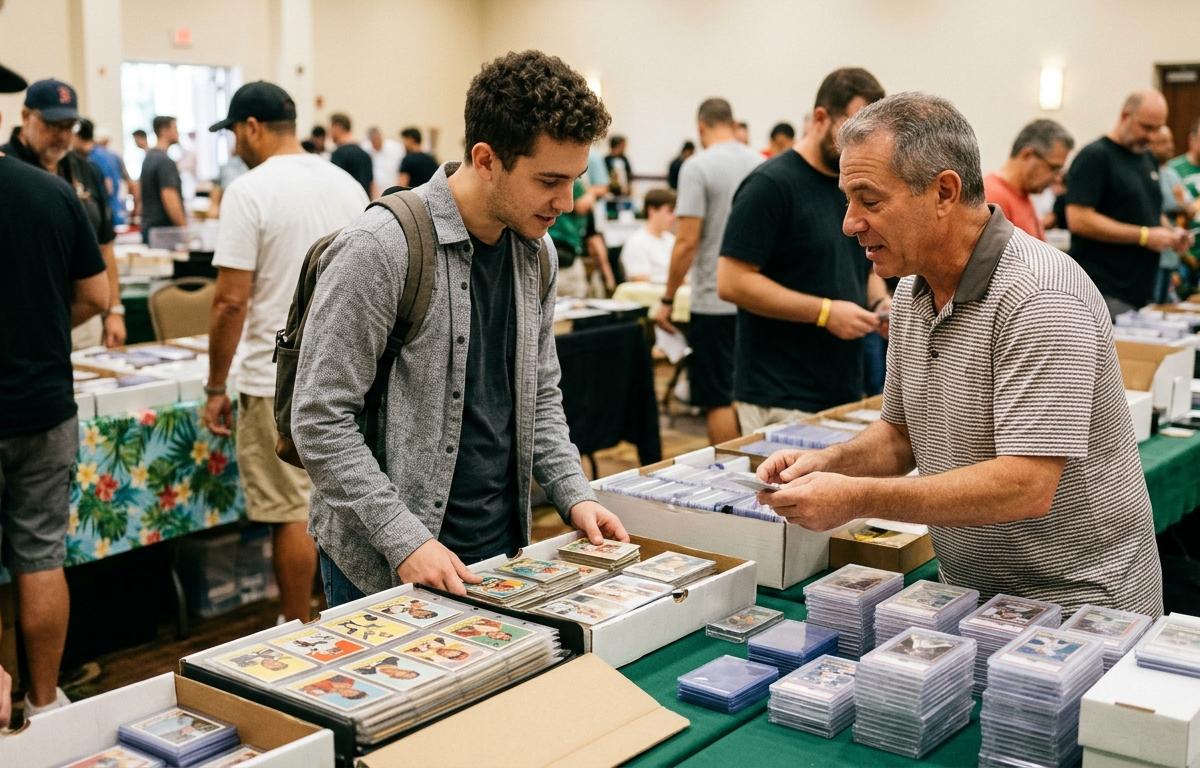
A card show is a room full of dealer tables where collectors buy, sell and trade cards in person. If you've only ever bought cards online or off a retail shelf, the scale can catch you off guard, so these card show tips for beginners are worth reading before you go. A beginner's guide to card shows lays out the basic setup well: dealers display inventory in cases, binders and boxes, and you browse at your own pace and negotiate directly with the person who owns the cards.
Expect a mix of everything. Sports cards sit beside Pokémon, One Piece and other trading card games. Some tables sell high-end graded singles in sealed cases, while others run bulk boxes where cards cost a dollar or less. That spread is good news for beginners, because there's something at almost any price point.
Large shows add extras on top of the tables. The Palm Beach Card Show, for example, lists autograph guests and on-site grading alongside its vendor floor, and a multi-day event like that has a different rhythm than a small one-day meetup. Crowds are usually thickest early, and aisles can get tight. Plenty of regulars treat a show as a social event as much as a shopping trip, so don't be surprised if a chat with a dealer runs longer than the sale itself.
One honest warning: your first show will probably feel overwhelming. That's normal. Most of the tips below come down to slowing down and walking in with a plan, so the room works for you instead of against you. If you're curious how the selling side differs, our piece on how to sell cards at a card show covers it from the other side of the table.
Planning Your Budget and Cash
Decide what you can comfortably spend before you walk in, and keep that money separate from whatever you need for parking, food or the drive home. Sources disagree on the "right" number. One guide suggests $200 to $500 in cash for a bigger show and $50 to $100 for a small one, while another puts a first-timer's range at $50 to $200 depending on show size and what you collect. Treat these as opinions, not rules. Your number depends on your hobby goals, and nobody should feel pressure to spend big on a first visit.
Cash matters at card shows more than most beginners expect. Many dealers prefer it, and some don't take cards at all. Those who do sometimes tack on a surcharge of a few percent to cover processing fees, though that varies by dealer and you shouldn't assume any specific figure. Bring a mix of small and large bills so you're not asking a dealer to break a hundred for a five-dollar card.
A few practical budgeting habits are among the most useful card show tips for beginners:
- Set a total spending cap and a separate cap for any single card.
- Write a short want list so you're not buying on impulse.
- Keep emergency funds out of your main stash.
- Pack light and carry only what you need. The SI collectibles beginner tips for sports card shows echo the common advice not to bring your whole collection, since a lost or stolen binder is a painful way to learn that lesson.
Admission is a separate line item. Tickets for the November 2026 Palm Beach show are sold through SimpleTix, and prices vary by ticket type, so check the current listing before you budget.
Scouting, Timing and Smart Buying
The most repeated of all card show tips for beginners is to walk the whole show before you buy anything. Spend your budget after visiting a handful of tables and you've got no idea whether you overpaid. A classic mistake is grabbing a card at table 5 and then finding the same card cheaper at table 150. Take a couple of laps first, noting prices and condition on anything you want, then circle back and buy.
Do some homework before you arrive. Look up recent sold listings on marketplaces like eBay or TCGPlayer for the cards on your want list. Show prices are asking prices, nothing more, and knowing what similar cards have actually sold for gives you a reference point so you can tell a fair deal from a markup.
Timing changes your odds of a good price. On the last day or in the final hours, dealers often want to move inventory rather than pack it up, so deals can get friendlier. On a multi-day show, early bargains can be harder to find, since a vendor may expect to sell a card at full price later in the weekend. The tradeoff is selection: the best pieces may be gone by the final afternoon. If there's one specific card you really want, buy it when you find it at a fair price rather than gambling that it'll still be there.
Don't ignore the cheap boxes either. Bulk bins are where beginners can explore a new corner of the hobby for very little money, and dealers generally appreciate customers who browse politely. For more on the kinds of tables you'll find, see our guide to a trading card show in South Florida.
Negotiation, Etiquette and Checking Condition
Yes, you can negotiate at a card show, and most dealers expect it. The trick is doing it respectfully. Offering $40 on a $100 card isn't negotiating, it's lowballing, and it tends to sour the conversation. A better approach is to ask something simple like "is there any flexibility on this?" and let the dealer respond. If you're buying several cards from one table, bundling them is a natural way to ask for a better total.
A few etiquette basics keep you in good standing with dealers:
- Ask before picking up a card, especially from a locked case or a graded slab.
- Don't spend 45 minutes pulling every $3 card out of a dollar box. Dealers frown on cherry-picking those bins.
- Be mindful in crowded aisles, and step aside when you want to read your notes or check your phone.
- Handle cards by the edges and put them back where you found them.
Condition is where beginners most often get burned. For raw, ungraded cards, look closely at corners, edges, surface and centering, and check for creases or print defects. Use good light, and ask to see a card out of its sleeve if the dealer is comfortable with that. Authenticity checks start with feel, print quality and card stock, and if something seems off, ask where the card came from. A reputable dealer will answer plainly. If the price on a high-value card seems too good to be true, slow down and ask yourself whether it's worth the risk.
Graded cards in sealed holders cut down on some of the guesswork, though you should still compare the grade to recent sales for that exact grade. The Palm Beach Card Show site notes on-site grading, which can be a handy way to learn how grading works in person.
Planning Your Visit to the Palm Beach Card Show
If you want a first show with plenty of variety, the next Palm Beach Card Show runs November 13 to 15, 2026, at the Palm Beach County Convention Center in West Palm Beach. You'll find venue details on the convention center's event page, and our overview of Palm Beach County Convention Center events covers the building itself.
Hours differ by day. General admission is listed as Friday 1pm to 7pm, Saturday 11am to 7pm and Sunday 10am to 4pm, with VIP early access listed at 11am Friday, 10am Saturday and 9am Sunday. Confirm those times and current ticket prices on the ticket page before you go, since details can change. Table counts are also advertised differently across the show's own pages, so treat any number as approximate and expect a very large floor either way.
How should a beginner use three days? If you want the best shot at selection, Friday afternoon or Saturday is a good fit. If you're chasing bargains and don't mind thinner stock, Sunday afternoon is when dealers may be more willing to move cards. A sensible plan for a first-timer is one longer visit: do your scouting laps early, make a short list of must-haves, and save your buying for the second half of your time there.
Practical notes help too. There's on-site parking, and the Hilton West Palm Beach connects to the facility by a covered walkway if you want to stay close. Wear comfortable shoes, bring water and a small bag, and carry cash in small and large bills. For more on planning the trip around the show, see our guide to the Palm Beach Card Show in 2026. Go in curious, ask questions, and follow these card show tips for beginners as you learn. The more you attend, the faster they become habits.